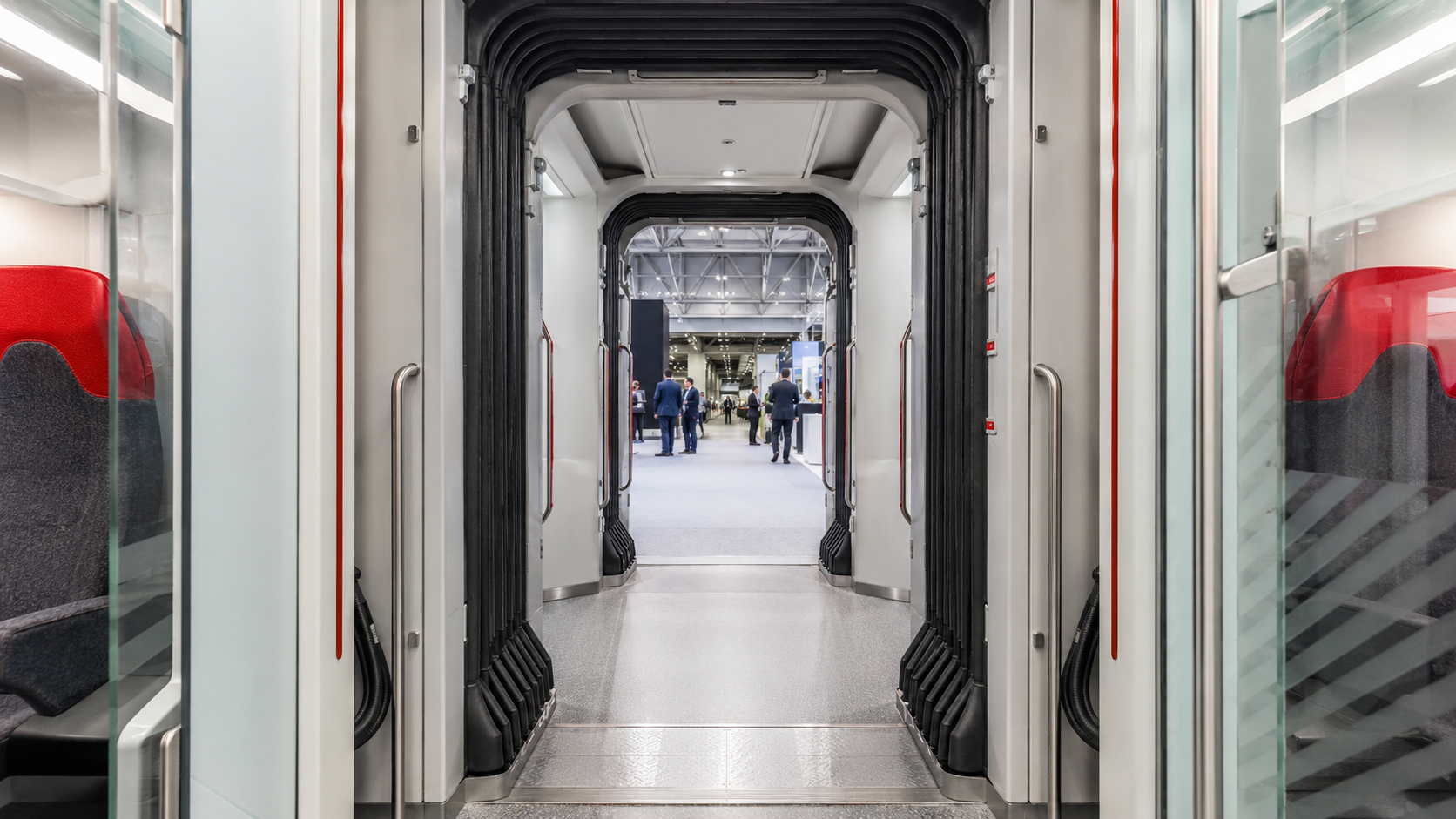
The passenger passes between the cars in a few seconds and rarely thinks about what exactly is happening with the structure around him. Meanwhile, two adjacent bodies during the movement are not in a fixed position: They move relative to each other in turns and on different parts of the path. The transition should take into account these movements and at the same time remain part of a safe passenger space.
Intercar Transition (disambiguation) — is the part of the rolling stock that connects adjacent cars, allows their relative movement and ensures the passage of passengers. Одновременно он выполняет функции шумо- и теплоизоляции и защищает пассажиров и обслуживающий персонал от воздействия внешней среды — осадков, пыли и ветра. Именно такое назначение зафиксировано в технических материалах компания Хюбнер.
This explains why the inter-car junction cannot be regarded as a normal corridor between two wagons. It works together with the rolling stock and must retain its functions when the train is moving.
What tasks does the inter-wagon transition
—'s First and Most Notable Task Safe passage of passengers. In modern trains, the transition helps to form a more connected passenger space and allows you to move between neighboring cars.
Second task — Compensation for reciprocal movements of bodies. Конструкция должна учитывать то, что соседние вагоны изменяют свое положение относительно друг друга во время движения. В продуктовых материалах компания Хюбнер эта функция отдельно обозначена как одна из ключевых характеристик межвагонного перехода.
The third group of tasks is related to the comfort and protection of the interior space. The transition contributes to noise and thermal insulation, provides protection of the zone between the wagons from external influences and helps to maintain the necessary tightness of the passage.
Thus, one system simultaneously works with the mechanics of the movement of the composition and with the requirements of the passenger environment.
Why there is no one crossing for all trains
At first glance, different inter-wagon transitions may look similar, but their size and performance are noticeably different.
Например, в продукции компания Хюбнер представлены отдельные решения для электропоездов ES1P, ES2G and ES2GP Swallow (TV series), for the EG2TV and EGE2TV Oriole (TV series), and trains EP2D, EP2DM and ED4M, Moscow Metro "Moscow-2020" and "Moscow-2024", passenger cars and rail buses.
It's not just the sizes that differ. For the "Swallow", for example, the materials indicate the inter-wagon transition assemblage, for the "Ivolga" — the version with handrails, and for metro trains and some other types of rolling stock, performances in the form of halves of inter-wagon transitions are used.
This is due to the fact that the system must be integrated into the design of a particular vehicle. Therefore, there is no universal answer to the question "which inter-wagon transition is better" without initial data on the rolling stock itself.
How to create a solution for a specific project
В материалах компания Хюбнер проектный цикл начинается с анализа параметров транспортного средства, условий эксплуатации и технических требований. Затем выполняется разработка или адаптация конструкции, проводится согласование, после чего изделие переходит в производство и испытания. Последним этапом становится сервисное сопровождение.
In practice, this means that vehicle data is important to start the engineering work: its design, the dimensions of the installation zone, the requirements for passage and the available design documentation. The more accurate the initial data, the more accurate it is possible to determine the execution of the future system.
For a new project, it may be necessary to adapt an existing solution, and in other cases, — will require more substantial design work. That is why in the B2B market, the inter-wagon transition is more often the Engineering Project, Not just a standard part.
Where inter-wagon crossings are used
The scope of application is much wider than one type of railway transport. The company's materials present solutions for electric trains, metro, suburban rolling stock, passenger cars and rail buses. Inter-car and inter-sectional systems are also associated with urban transport.
A good example of the differences between — trains and multi-section trams. The basic task is similar: connect the two parts of the vehicle and provide a safe area between them. But the features of kinematics and design differ so much that in the tram, together with the flexible bellows, the upper and lower joint systems work separately. Therefore, for urban electric transport, the company allocates bellows and articulation systems in independent product directions.
This is one of the main principles of transport engineering: The purpose of the system may be similar, but the design is determined by the vehicle itself.

What Happens After Manufacturing
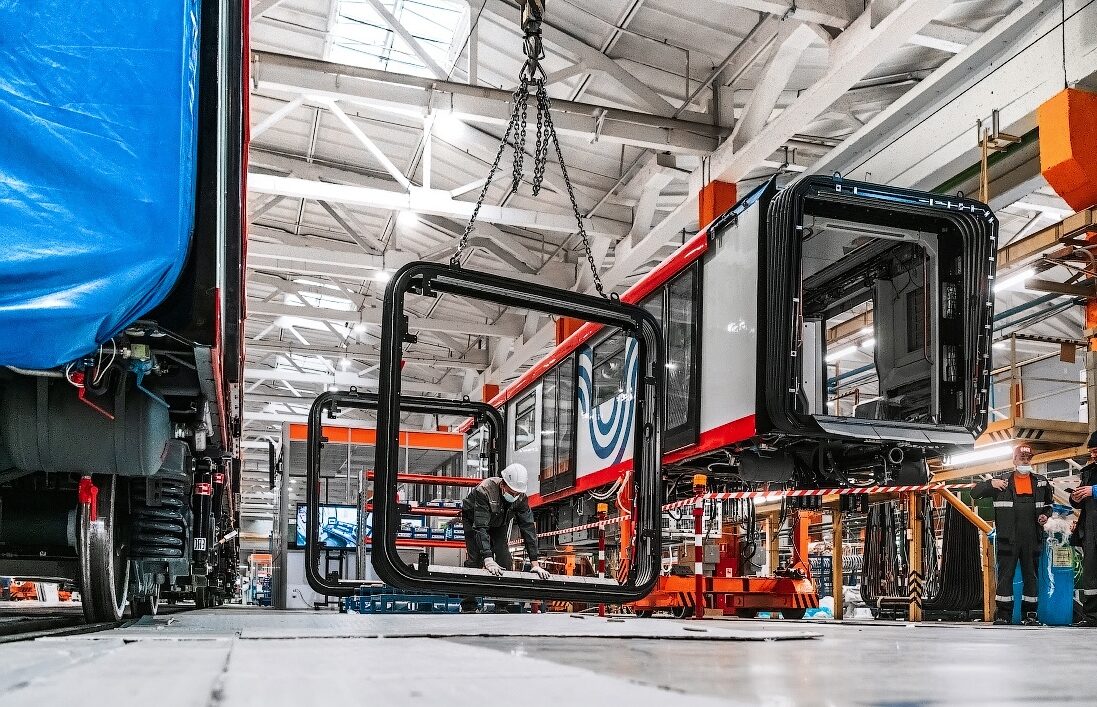
After production, the product must undergo the necessary inspections and acceptance. In the materials of the company, quality control is considered as a process that goes from the incoming control of materials to the inspection of the finished product. Tests are provided in accordance with the technical requirements of a particular project.
Компания Хюбнер также развивает собственные испытательные возможности. В интервью руководства 2025 года сообщалось о приобретении стенда, позволяющего моделировать работу межвагонных переходов и проверять функциональность и надежность конструкции непосредственно на предприятии.
For the industry customer, this is especially important: The design or design model should eventually turn into a physical product capable of performing the required movements and retaining characteristics in operation.
Inter-car crossing as part of the train life cycle
Work with the system does not end after its installation on a new rolling stock. Inter-wagon junctions have been in operation for many years, so the tasks of diagnosing, maintaining, repairing and replacing individual components or the entire system later arise.
The company's materials note that the first railway intercar junctions were delivered to the Russian market in 2011, and the service life of many such systems is about 12–15 years. For this reason, the modernization and maintenance of previously delivered products become a separate area of engineering work.
As a result, the modern inter-wagon transition is more correct to consider not as a separate part of the car, but as a system that passes along with the rolling stock several stages: design → production → testing → operation → service → modernization or replacement.
And it is the requirements at all these stages that should be taken into account already at the time of choosing or developing a solution.