Bus and electric bus transport combines a wide range of engineering tasks. Some components work directly in the area of connection of two sections of the articulated vehicle, others are responsible for safe and convenient access of passengers, others are integrated into the internal and external contour of the body.
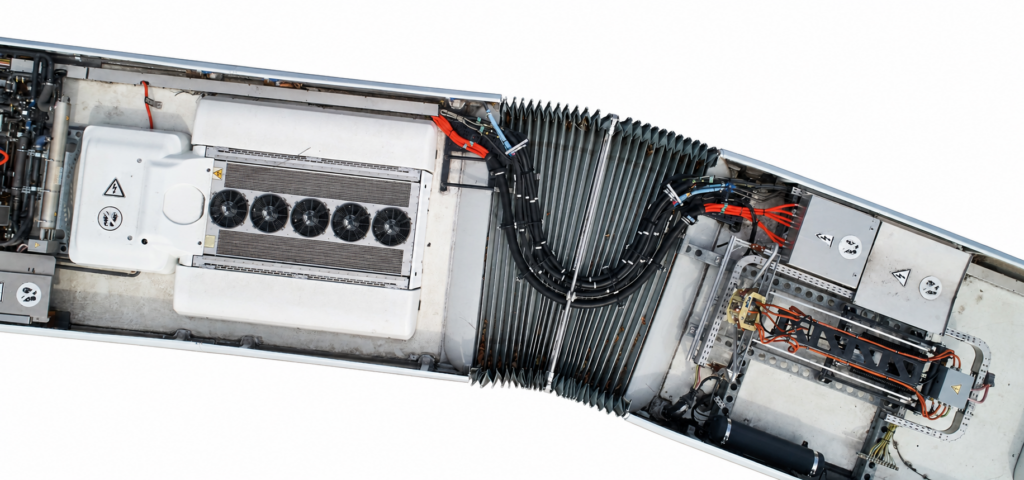
For an articulated bus, the most technically saturated area is the connection of the front and rear sections. While driving, they change position relative to each other, so the passenger passage must retain functionality, the — mechanical system provides communication between sections, and the — engineering communications pass through the mobile zone taking into account its work. In project materials, this task is divided into four main elements: articulation system, articulation system, power wiring system and bellows.
But the bus route is not limited to this.
The articulated — bus is two movable sections that must operate as a single vehicle.
In an articulated bus, the connection of sections performs several functions at once. The design should allow two parts of the vehicle to move relative to each other when driving, provide passenger communication between the cabins and maintain the operability of engineering systems passing through this area.
That is why the materials of the Hübner company for the bus direction together list the systems of articulation nodes, articulation systems, power wiring systems and bellows. This is not a random set of products, but functionally related groups of components of one zone of the vehicle.
Externally, the passenger perceives the place of connection of sections as one passage with the "harmony". For an engineer inside the same area, it is necessary to solve the mechanical connection of the bodies, the operation of the mobile part, the transmission of communications and the protection of the passenger area.
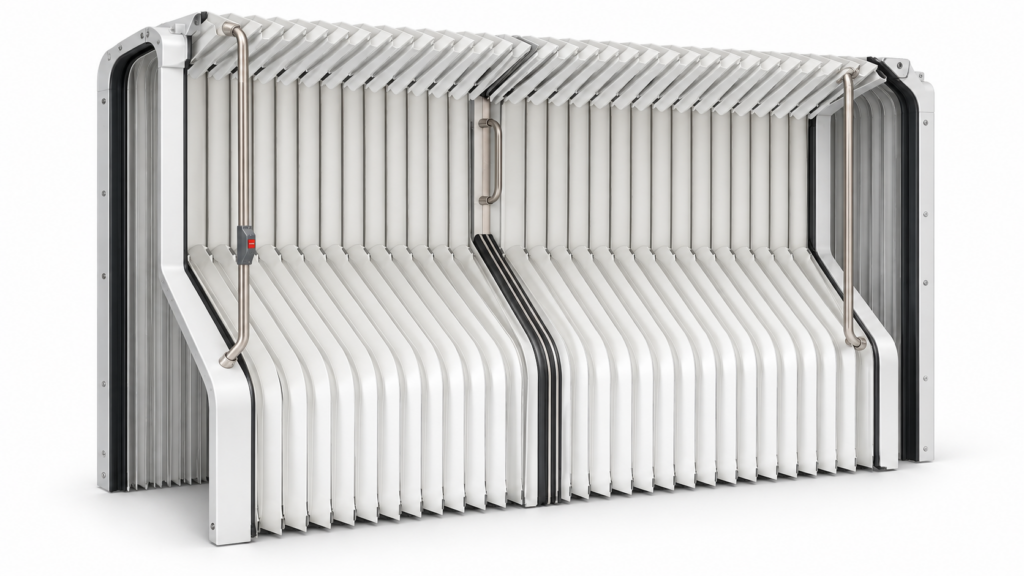
Bellows form a protected passage between sections
The most detailed product confirmed bus direction — bellows for low-floor articulated bus LiAZ-6213.
In the technical material, the wave bellows are described as part of an articulated bus that allows the relative movement of body parts, serves for the passage of passengers and provides noise, thermal insulation and protection of the passenger area from the effects of precipitation, dust and wind.
For LiAZ-6213 presented bellows 04211060400. The original materials for it confirmed the dimensions of 1735 × 2470 × 2474 mm, the width of the passage 1350 mm and the height of the passage 1926 mm. The product is entered in the Register of Russian industrial products.
What tasks arise in the bus transport project
| Zone / task | What needs to be decided | The Applicable Solutions |
|---|---|---|
| Connection of sections of the articulated bus | Provide a functional connection between the front and rear of the vehicle | Interconnection system (disambiguation) |
| Dynamics of the articulation zone | Ensure the operation of the connection when the vehicle is moving | Articulation systems, articulation systems |
| Passage between sections | Create a protected transition with relative body movement | Category: Bellows (musician) |
| Engineering communications between sections | Organize the transmission of communications through a mobile area | Power wiring systems, cable and hose laying systems |
| Entry and exit of passengers | Increase vehicle availability | Passenger access facilities |
| Local protection and sealing | Protect individual zones and interfaces of the structure | Elements of protection |
| Interior and Exterior | Integrate additional functional and finishing elements | Finishing and other internal/external components |
| Operation after delivery | Provide support and restore the performance of components | Service and technical advice |
The articulation system and the work of the articulation zone work inside the passenger passage
Behind the outer shell of the bellows is the mechanical part of the connection of the sections. In the presentation materials, the Hübner company for articulated buses separately singled out articulation node systems and articulation systems.
Engineering communications also pass through the joint zone
Connecting bodies is not enough. Between sections of the vehicle must pass engineering communications, and they are in the same movable area.
Therefore, in the bus direction, energy wiring systems are separately presented, and in the current product structure of —, cable and hose laying systems are adapted for a specific project.
In materials on bellows and power wiring, the purpose of such systems is associated with the protected placement of engineering communications in the joint zone.
mechanics connects the body → the bellow protects the passenger passage → the power wiring systems organize communications.
For buses and electric buses, not only the joint area is important
Not every bus or electric bus is articulated.
Their task is — to solve the issues of passenger access, protection of individual zones and integration of components into the interior and exterior of the vehicle. The overall product structure also includes protective elements, finishing elements for interior and exterior decoration.
The component must conform to the design of the particular vehicle
Bus transport has a large variability of layouts: classic and articulated bodies, different passenger passages, options for doors, engineering tracks and internal elements. Therefore, even in the presence of a finished product group, the applicability of a particular component must be determined from the initial data of the project.
In the design materials, the cycle of work is described as: application of the customer → consultation → joint development → design or adaptation of the product → production → supply → warranty and service.
It is these raw data that make it possible to determine whether an existing solution is suitable or whether an engineering adaptation is required.
Operation continues after delivery
For buses operating in regular urban operation, it is important not only the initial choice of component, but also the possibility of subsequent technical support.
In the service materials, Hübner company indicates the repair and restoration of the operability of bellows and other components in the warranty and post-warranty period. The availability of spare parts, prompt response to requests, support during the period of product operation and the availability of its own design service were also noted.